Quantities of Motion
Syllabus mapping
PY-11-01 — Fundamentals of Mechanics. Covers: scalar and vector quantities used in describing motion (distance, displacement, speed, velocity, acceleration); representing vectors graphically; adding and subtracting vectors, including resolving a vector into perpendicular components; distinguishing instantaneous and average speed/velocity.
Wording above is paraphrased for teaching use — cross-check against the official syllabus PDF (see Resources) before treating any line as verbatim NESA text.
You need to know: the difference between a scalar and a vector, how to add/subtract vectors (graphically and by components), and the difference between average and instantaneous speed/velocity — everything else in Mechanics builds on this.
Assumed knowledge check
Before this page makes sense, you should be comfortable with:
- Vectors — adding, subtracting, resolving into components
- Trigonometry — SOH-CAH-TOA, needed to resolve vectors
Core
Two cyclists, one café
Two cyclists leave home at the same time, both heading for the same café — but they ride completely different routes.
- Cyclist A takes the direct route: straight down the main road (3 km east), then turns onto the bike path (4 km north) — 7 km of riding in total.
- Cyclist B takes the scenic route along the river trail, winding around for 9 km before arriving at the same café.
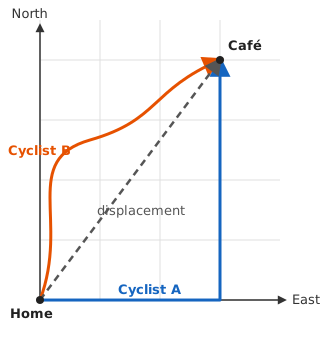
Before reading on — have a think: did the two cyclists end up in the same place? Obviously yes, they're both at the café. But how far did each of them actually ride? Clearly not the same — one covered 7 km, the other 9 km, despite finishing in exactly the same spot.
That's the whole point of this page: there are two genuinely different, both completely valid, ways to answer "how far did they go?" — and physics needs a separate word for each one. Keep this picture in mind; we'll come back to these two cyclists more than once, including for a genuinely surprising result once we get to speed and velocity.
Scalars vs vectors
A scalar is fully described by a magnitude (a number and a unit) alone. A vector needs a magnitude and a direction.
Vectors will often, but not always be shown with an arrow above the vector quantity, such as \(\vec{s}\) for displacement, or \(\vec{v}\) for velocity. Generally 'v' without the arrow hat is referencing just the magnitude, or the speed part, of the velocity.
Take the context from the question though as it will vary depending on the text or website you are viewing (sometimes it's just a limitation of what the website can visually show - so use your intelligence to work out what they are referring to!).
| Scalar | Vector |
|---|---|
| Distance | Displacement |
| Speed | Velocity |
| — | Acceleration |
| Time, mass, energy | Force |
- Distance — total path length travelled. Always positive, never decreases. This is why our two cyclists have different distances (7 km and 9 km) — they took different paths.
- Displacement, \(\vec{s}\) — straight-line distance and direction from start to finish. Can be zero even after a long trip, if you end up back where you started. This is why our two cyclists have the same displacement (5 km, 53° north of east, or N37°E) — displacement only cares about the start and finish points, never the path taken to get there.
Worked example
A student walks 8 m east, then 6 m north.
- Distance travelled: \(8 + 6 = 14\ \text{m}\)
- Displacement: the straight-line vector from start to end. Magnitude by Pythagoras:
Direction: \(\theta = \tan^{-1}\left(\dfrac{6}{8}\right) \approx 37^\circ\) north of east.
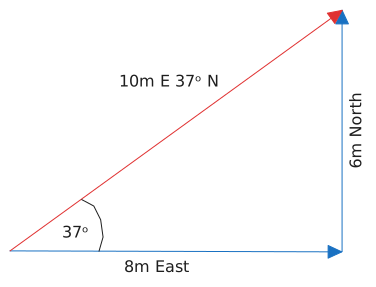
So the displacement is 10 m, E37°N — distance and displacement give different answers from the same trip.
Standard quantities and SI units in physics
There are several standard or fundamental measurements used for science, physics in particular. Common ones that you should have already encountered in stage 4 and 5 include:
| Component | What is measured | SI or Standard Units |
|---|---|---|
| distance (or length) | total path length travelled. Always positive, never decreases. A scalar quantity | metres (m) |
| displacement | The straight-line distance and direction between two points. The straight line distance measured from a set reference point. A vector quantity | metres (m) |
| time | the duration of events | seconds(s) |
| force | a measurement of a drive to change motion or shape of a object | Newtons (N) |
| mass | the amount of matter present in an object or system | kilograms (kg) |
| weight | is a force of gravity acting on a mass - those two terms often get used interchangably but are different in physics | Newtons(N) |
There are others (acceleration, energy, temperature etc) - but these are the primary ones you should already be familiar with for Dynamics (Forces) and Kinematics (Motion). We will define acceleration as part of this course.
The units are important. The formulas and equations we will be using are constructed on the assumption you are using SI units. This means if you use cm instead of m for distance, or g instead of kg for mass that your calculated values will likely be wrong! You should know how to convert between units of measurement already - see the assumed knowledge section if you have forgotten.
Speed vs velocity
- Speed, \(v\) — rate of change of distance. Scalar.
- Velocity, \(\vec{v}\) — rate of change of displacement. Vector (has direction).
Helpful Hint
Any time you see 'rate of change' or even 'rate' in a definition in Physics, there will almost certainly be 'divided by time' in the subsequent equation or formula.
Worked example — back to our cyclists
Remember Cyclist A (7 km, direct route) and Cyclist B (9 km, river trail) from earlier — both leaving Home and arriving at the same Café, 5 km away at 53° north of east, in exactly the same time: 30 minutes.
Average speed (uses distance, so it's different for each cyclist):
Average velocity (uses displacement, which is identical for both):
Cyclist B was genuinely riding faster (\(18\ \text{km h}^{-1}\) vs \(14\ \text{km h}^{-1}\)) — but their average velocity comes out identical, because velocity only depends on where you start and finish and how long it takes, never on the actual path ridden in between. This is exactly why speed and velocity aren't just "the same thing with an optional direction stapled on" — they can give completely different answers to "how fast were they going?", and only one of them cares about the route taken.
Average vs instantaneous:
- Average velocity is measured over an interval — total displacement divided by total time.
- Instantaneous velocity is the velocity at one specific moment — what a speedometer shows right now, not the trip average.
For an object with changing speed, these are usually different. A car's speedo doesn't read its average speed for the whole journey — it reads instantaneous speed at that instant.
Worked example
A runner competing in the 400m in lane 1 starts and ends their race on the finish line. Their instantaenous velocity might be 30km/h, or 8.3m/s in SI units, in whatever direction they are facing along the track at that point.
But their average velocity will be zero, as their displacement for the whole race is zero (They start and finish at the same point, so their total displacement is zero). This will not be true for any of the other runners as they start in a staggered position on the track, so their total displacement will be greater than zero.
Obviously while correct, this is not always a helpful measurement - like everything, apply appropriate understandings and techniques to any scenario to get useful information out of it! for a 400m race, average speed will be far more useful than average velocity!
Drawing vectors
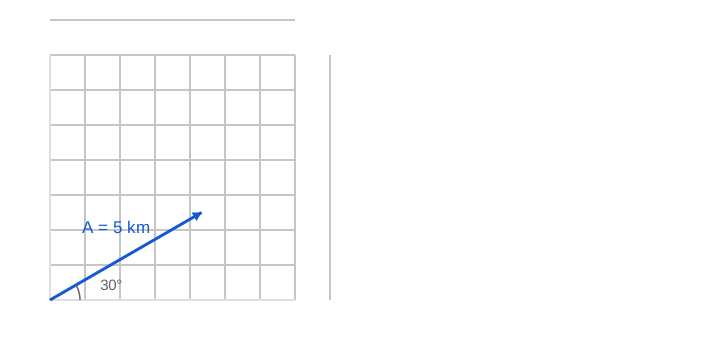
A vector drawn to scale, showing both a magnitude (its length) and a direction (its angle from a reference line).
Vectors are drawn as arrows: length represents magnitude (to scale), the arrow direction represents direction.
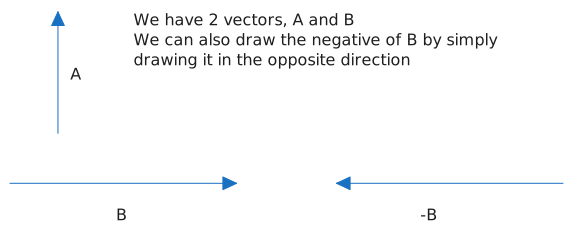
To draw a negative vector you keep the magnitude the same, but rotate the direction 180 degrees. For example - if vector A is a velocity, 20m/s to the East, then -A or negative A is 20m/s to the West

Vector addition
There are two common ways to add vectors:
Draw the first vector, then start the second vector's tail at the first vector's tip. The resultant is the single vector from the start of the first to the tip of the last. Good for building intuition and rough checks, but precision is limited by how carefully you draw and measure.
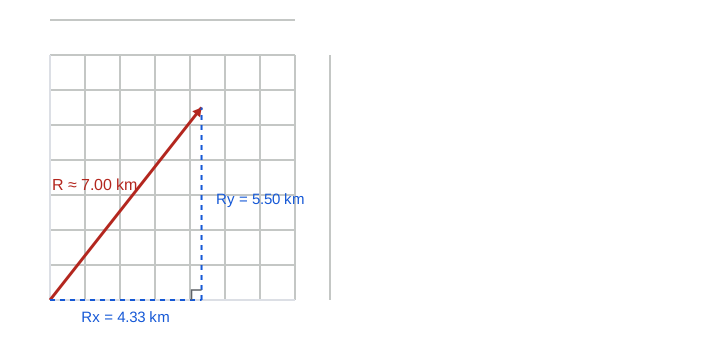
Resolve each vector into perpendicular (usually x and y) components, add the components separately, then recombine.
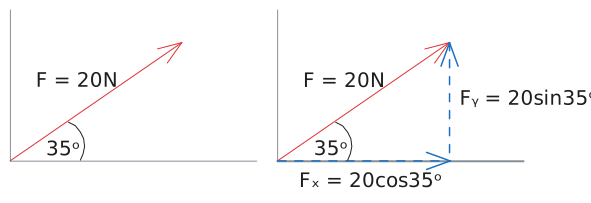
For a vector \(\vec{A}\) of magnitude \(A\) at angle \(\theta\) from the x-axis:
Worked example — resolving a single vector
A force of \(20\ \text{N}\) acts at \(35^\circ\) above the horizontal. Find its horizontal and vertical components.
Check it's sensible: since \(35^\circ\) is closer to horizontal than vertical, the horizontal component should be the larger one — it is.
To add \(\vec{A}\) and \(\vec{B}\):
This is the method that scales to exam-style problems — always show the component working, not just a final number.
Worked example - graphical method
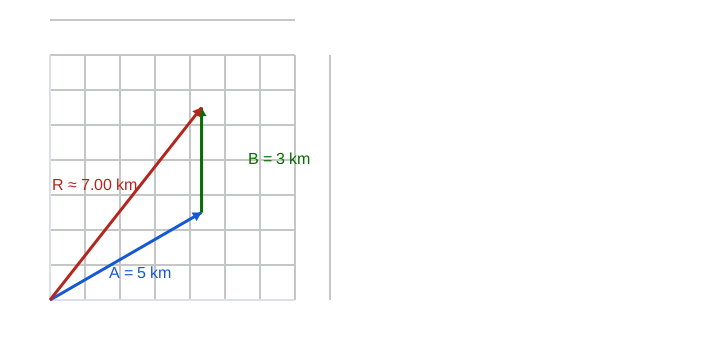
If we draw the vectors to scale, starting the second from the tip of the first, we can measure the length of 'R' to find the value as 7km. A protractor would let us measure the angle to be \(52^\circ\). This is good - but requires accurate drawings and measuring tools, or a computer aided drawing system.
Worked example — component method
A hiker walks 5 km at 30° north of east, then 3 km due north. Find the total displacement.
Vector 1 (\(30^\circ\) from east): \(A_x = 5\cos30^\circ = 4.33\ \text{km}\), \(A_y = 5\sin30^\circ = 2.50\ \text{km}\)
Vector 2 (due north): \(B_x = 0\), \(B_y = 3\ \text{km}\)
Resultant components: \(R_x = 4.33\ \text{km}\), \(R_y = 5.50\ \text{km}\)
Subtraction of vectors
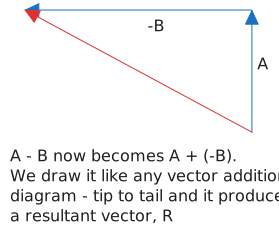
Subtraction of vectors is effectively just addition of a negative vector. In the same way the 4 - 2 is the same as 4 + (-2), so two vectors, A - B is the same as A + (-B).
To do that visually we draw the negative of the second vector, then draw a tip to tail addition diagram. It would look like:
Worked example — subtracting vectors
A cyclist's velocity changes from \(\vec{v}_i = 5\ \text{m s}^{-1}\) east to \(\vec{v}_f = 5\ \text{m s}^{-1}\) north. Find the change in velocity, \(\Delta\vec{v} = \vec{v}_f - \vec{v}_i\).
This is \(\vec{v}_f + (-\vec{v}_i)\): keep \(\vec{v}_f\) (5 m s⁻¹ north) as it is, and reverse \(\vec{v}_i\) to get \(-\vec{v}_i\) — 5 m s⁻¹ west (same magnitude as the original eastward vector, opposite direction). Add these two tip-to-tail; since they're perpendicular, Pythagoras gives the magnitude:
Notice this isn't "5 minus 5" — vectors don't subtract like scalars just because the numbers look the same. The cyclist's speed never changed, but their velocity did (direction changed), and that shows up as a genuinely large \(\Delta\vec{v}\) rather than zero.
Try it yourself: A ball's velocity changes from \(4\ \text{m s}^{-1}\) north to \(3\ \text{m s}^{-1}\) south. Find \(\Delta\vec{v}\).
Answer
\(-\vec{v}_i\) is \(4\ \text{m s}^{-1}\) south. Since \(\vec{v}_f\) (3 m s⁻¹ south) and \(-\vec{v}_i\) (4 m s⁻¹ south) point the same direction, they add directly rather than needing Pythagoras: \(\Delta\vec{v} = 3+4 = 7\ \text{m s}^{-1}\) south.
Advanced
Combining three or more vectors, and non-right-angle problems. The component method extends directly to any number of vectors — sum all the x-components, sum all the y-components, then recombine. This is also the standard approach when vectors aren't conveniently perpendicular to begin with: resolve everything onto a common x–y axis first, even if none of the original vectors line up with those axes.
Vector subtraction in component form. If you haven't already, make sure subtracting vectors above is solid before this — that section covers the concept (\(\vec{A}-\vec{B}=\vec{A}+(-\vec{B})\)) from scratch. The component-method version of the same idea: to subtract \(\vec{B}\), just flip the sign of both its components before adding, rather than redrawing it reversed. This matters for change-in-velocity problems (\(\Delta \vec{v} = \vec{v}_f - \vec{v}_i\)) later in Momentum and Energy, and comes back explicitly in relative velocity in Motion Relationships — being solid on subtraction now avoids a stall later.
Extension
Beyond the Physics 11–12 syllabus — won't appear in the HSC, included for interest / depth study inspiration.
📎 Depth study idea
Instantaneous velocity is formally the derivative of displacement with respect to time, \(\vec{v} = \dfrac{d\vec{s}}{dt}\) — the average-velocity formula is really just the gradient of a secant line on a displacement–time graph, and instantaneous velocity is what that gradient approaches as the time interval shrinks to zero (the gradient of the tangent). Students doing Extension 1/2 Maths will recognise this immediately as a limit definition of a derivative. Worth a genuine depth study if you want to connect kinematics to calculus explicitly — e.g. deriving the SUVAT equations from \(a = \frac{dv}{dt}\) by integration, rather than taking them as given — see the worked derivation in the Extension box on Motion Relationships.
Video/visual resources
🖥️ PhET Simulation — Vector Addition
If the simulation doesn't load (some school networks block embedded content), open it directly: PhET — Vector Addition
🖥️ PhET Simulation — Moving Man
Good fit for the speed-vs-velocity and instantaneous-vs-average content above — drive the man's position/velocity/acceleration directly and watch the live graphs respond.
If the simulation doesn't load (some school networks block embedded content), open it directly: PhET — Moving Man
🖥️ GeoGebra — Resolution of Vectors
Drag the vector and watch its horizontal/vertical components update live — good for building intuition before the resolving-into-components worked example above.
If the widget doesn't load (some school networks block embedded content), open it directly: GeoGebra — Resolution of Vectors
- 🎥 Khan Academy — Intro to vectors and scalars
- 🎥 Khan Academy — Vector components from magnitude and direction
- 🎥 Khan Academy — Adding and subtracting vectors
- 🎥 Physics High — Understanding vectors
Check yourself
-
A cyclist rides 400 m east, then 300 m south. Calculate (a) the distance travelled and (b) the magnitude and direction of the displacement.
Answer
(a) Distance \(= 400 + 300 = 700\ \text{m}\)
(b) \(|\vec{s}| = \sqrt{400^2 + 300^2} = 500\ \text{m}\), direction \(\theta = \tan^{-1}(300/400) \approx 37^\circ\) south of east.
-
Explain why a car's average velocity over a full lap of a circular track is always zero, even though its average speed is not.
Answer
Displacement is start-to-finish in a straight line — a full lap ends where it started, so the displacement vector is zero, making average velocity zero. Distance travelled (the full lap length) is not zero, so average speed is not zero. This shows why speed and velocity aren't interchangeable.
-
A boat's velocity has components \(v_x = 6\ \text{m s}^{-1}\) and \(v_y = 8\ \text{m s}^{-1}\). Find the magnitude and direction of the resultant velocity.
Answer
\(|\vec{v}| = \sqrt{6^2 + 8^2} = 10\ \text{m s}^{-1}\)
\(\theta = \tan^{-1}(8/6) \approx 53^\circ\) from the x-axis (whichever direction that axis represents)