Forces and Motion
Syllabus mapping
PY-11-01 — Fundamentals of Mechanics. Covers: resolving forces into perpendicular components; representing forces on free-body diagrams; Newton's three laws of motion; force problems involving connected bodies; static and kinetic friction.
Wording above is paraphrased for teaching use — cross-check against the official syllabus PDF (see Resources) before treating any line as verbatim NESA text.
You need to know: how to resolve a force into components, draw a correct free-body diagram, apply all three of Newton's laws, and handle friction and connected-body problems.
Assumed knowledge check
Before this page makes sense, you should be comfortable with:
- Trigonometry — SOH-CAH-TOA
- Quantities of Motion — the component method, applied here to forces instead of displacement/velocity
Advanced
Not explicitly necessary for the HSC Physics course, but being familiar with both the Sin Rule:
and the Cos rule:
can be helpful for solving more advanced questions and complex equations quickly, without needing to resort to resolving all vectors.
Core
Newton's First Law
An object remains at rest, or moving at constant velocity, unless acted on by a net (unbalanced) force. This is inertia — an object's resistance to a change in its motion. A book sitting on a table isn't "at rest because there's no force on it" — gravity and the normal force are both acting, they just balance to a net force of zero.
Put simply - if it is not moving, it will stay in place until something pushes it. If it is already movign, it will keep going until something else either stops it, or changes how it is moving.
Newton's Second Law
The acceleration of an object is directly proportional to the net force acting on it, and inversely proportional to its mass.
ie, if you push it harder, it accelerates faster!! If it's bigger (heavier), you will need to push it harder to get the same acceleration as you would on a smaller (lighter) object.
Worked example
A \(1200\ \text{kg}\) car experiences a net forward force of \(3000\ \text{N}\). Find its acceleration.
Newton's Third Law
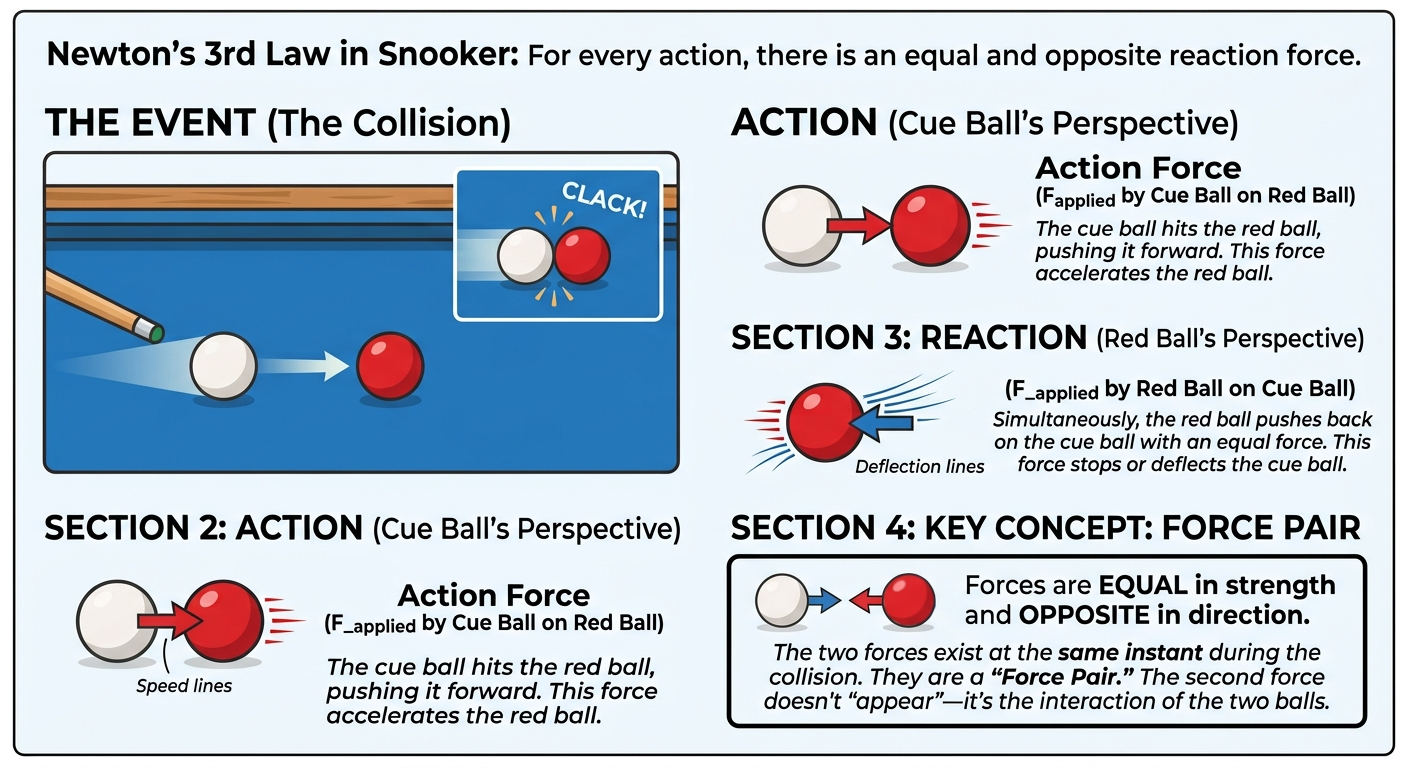
For every action force, there is an equal and opposite reaction force. Crucially, these two forces act on different objects — that's why they don't cancel each other out. When you push on a wall, the wall pushes back on you with equal force; those two forces act on you and the wall respectively, not both on you, so there's no contradiction with the wall staying still.
This is one of the harder concepts to grasp. The law basically means forces (almost) always come in pairs. The pairs are equal in magnitude (size) and opposite in direction.
Imagine two snooker balls. You hit the cue ball and it starts moving towards the second ball. When it collides the second ball shoots away and the cue ball stops. Or maybe they both go off at angles. In either case, both balls have changed either speed and/or direction. Because we've already looked at Newton's first law, we understand that means both balls have experienced a force! But you only hit the cue ball - so where did the second force come from? From the second ball acting (applying a force) on the first.
Weight force
Mass (kg) is a property of the object — how much matter it contains. Weight (N) is a force — how strongly gravity pulls on that mass, so it depends on location (weight on the Moon is roughly a sixth of weight on Earth for the same mass).
Resolving forces into components
Exactly the same method as resolving displacement/velocity vectors, applied to forces:
This is the tool that makes free-body diagrams solvable algebraically rather than just descriptively — resolve every force onto a common pair of axes, then apply Newton's second law separately in each direction.
Free-body diagrams
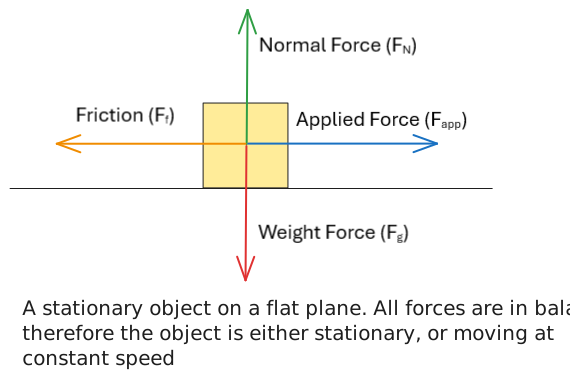
Draw every force acting on the object (never forces the object exerts on something else — that's a Newton's third law pair, not part of this object's free-body diagram). Common forces to check for: weight, normal force, applied force, friction, tension.
This is the house style used for every free-body diagram on the site (also on Motion on Inclined Planes and in Connected Bodies below). Colour convention: weight red, normal force green, applied force blue, friction orange, tension purple.
Friction
where \(\mu\) is the coefficient of friction and \(F_N\) is the normal force. Static friction resists an object starting to move (it adjusts up to a maximum value as the applied force increases); kinetic friction acts once the object is already sliding, and is usually slightly less than the maximum static friction (this is why it's easier to keep an object sliding than to start it sliding).
Worked example
A \(20\ \text{kg}\) crate sits on a horizontal floor with \(\mu_k = 0.3\). A horizontal force of \(80\ \text{N}\) is applied. Find the acceleration.
Normal force: \(F_N = mg = 20 \times 9.8 = 196\ \text{N}\)
Kinetic friction: \(f = \mu_k F_N = 0.3 \times 196 = 58.8\ \text{N}\)
Net force: \(F_{net} = 80 - 58.8 = 21.2\ \text{N}\)
Connected bodies
When two objects are connected (by a string, or simply pushed against each other), they share the same acceleration magnitude, but each object needs its own free-body diagram and its own application of \(\vec{F}_{net} = m\vec{a}\).
The worked example below, built up in three steps:
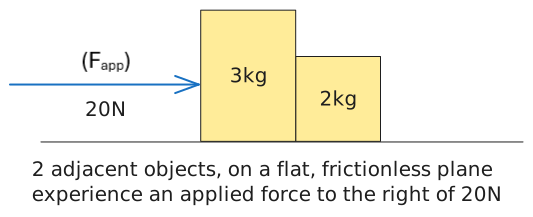
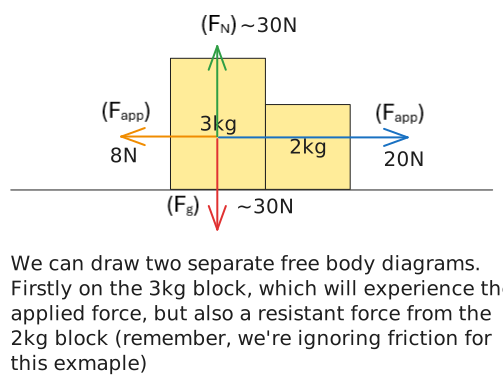

The contact force appears on both free-body diagrams, equal in magnitude and opposite in direction — a direct picture of Newton's Third Law.
🖼️ Still TODO — a second diagram for the Atwood-style pulley case (one hanging mass, one mass on a surface, string over a pulley) as two separate per-object free-body diagrams with tension shown acting on both.
Worked example
Two blocks, \(m_1 = 3\ \text{kg}\) and \(m_2 = 2\ \text{kg}\), sit in contact on a frictionless surface. A horizontal force of \(20\ \text{N}\) pushes \(m_1\) into \(m_2\). Find the acceleration of the system and the contact force between the blocks.
Treat both blocks as one system to find acceleration:
Now isolate \(m_2\) alone — the only horizontal force on it is the contact force \(F_c\) from \(m_1\):
Practical
Suggested prac: force–mass–acceleration relationship, e.g. a trolley on a track pulled by a falling mass over a pulley, varying either the pulling force or the trolley's mass and measuring resulting acceleration (via light gates or a motion sensor), then checking the result against \(F_{net} = ma\). TODO — link this school's actual prac instructions once written.
Advanced
Multi-body and pulley systems. The same isolate-each-object method from the connected-bodies example above extends to Atwood machines (two masses connected over a pulley, one hanging) and three-or-more-body systems — the key discipline is always drawing a separate free-body diagram per object and writing a separate \(F_{net}=ma\) equation for each, then solving simultaneously.
Combining friction with connected bodies — e.g. one block on a rough horizontal surface connected via a string over a pulley to a hanging mass — requires resolving friction into the same per-object equations rather than treating the system as frictionless.
Extension
Beyond the Physics 11–12 syllabus — won't appear in the HSC, included for interest / depth study inspiration.
📎 Depth study idea
Newton's second law as usually written, \(\vec{F}_{net} = m\vec{a}\), assumes constant mass. The more general form is actually
where \(\vec{p} = m\vec{v}\) is momentum (covered properly in Momentum and Energy). For constant mass, \(\frac{d\vec{p}}{dt} = m\frac{d\vec{v}}{dt} = m\vec{a}\), recovering the familiar form — but the momentum version also correctly handles situations where mass changes over time, like a rocket burning fuel or a raindrop accumulating moisture as it falls. Worth a depth study if a student wants to model one of those variable-mass scenarios properly rather than assuming constant mass throughout.
Video/visual resources
- 🖥️ PhET Simulation — Forces and Motion: Basics — TODO: confirm current PhET link
- 🎥 Khan Academy — TODO: source a Newton's laws explainer. Must cover all three laws with everyday examples, and ideally the "forces act on different objects" point for Newton's Third (students consistently think action/reaction cancel on the same object). ~10-15 min, essential.
- 🎥 Physics High — TODO: check for a NSW-syllabus-aligned forces video, ideally covering free-body diagrams and friction (static vs kinetic) specifically, since that's the exam-relevant application beyond just stating the laws. Essential if found — this is core exam content.
Check yourself
-
A \(5\ \text{kg}\) object experiences a net force of \(15\ \text{N}\). Find its acceleration.
Answer
\(a = \dfrac{F_{net}}{m} = \dfrac{15}{5} = 3\ \text{m s}^{-2}\)
-
A \(10\ \text{kg}\) box on a horizontal floor has \(\mu_s = 0.4\). What's the minimum horizontal force needed to start the box moving?
Answer
\(F_N = mg = 10 \times 9.8 = 98\ \text{N}\)
Maximum static friction: \(f_{s,max} = \mu_s F_N = 0.4 \times 98 = 39.2\ \text{N}\)
The applied force must exceed this to start motion, so the minimum force is just over \(39.2\ \text{N}\).
-
Two blocks (\(4\ \text{kg}\) and \(6\ \text{kg}\)) are connected by a light string and pulled across a frictionless surface by a \(30\ \text{N}\) horizontal force applied to the \(6\ \text{kg}\) block (with the string connecting to the \(4\ \text{kg}\) block behind it). Find the acceleration and the tension in the string.
Answer
System acceleration: \(a = \dfrac{F}{m_1+m_2} = \dfrac{30}{10} = 3\ \text{m s}^{-2}\)
Isolating the \(4\ \text{kg}\) block — the only horizontal force on it is the string tension:
\(T = m a = 4 \times 3 = 12\ \text{N}\)