Physics — Assumed Knowledge
The Physics syllabus repeatedly assumes Year 10 skills without restating them. Also, some of these skills are covered in the year 11 course, but are then assumed knowledge for year 12 Physics. Use this page as a refresher if needed!
Status
All eight sections drafted. This page is a refresher, not new syllabus content — it's deliberately lighter-touch than a Year 11 topic page (no syllabus mapping, no Advanced/Extension tiers), just enough to unblock whichever Year 11 page sent you here.
Vectors
Needed immediately in Quantities of Motion and Forces and Motion, and again throughout the rest of the course. Quantities of Motion now covers all of this in full — worked examples, diagrams and an interactive for adding, subtracting and resolving vectors into components — so this is just the quick refresher if any of it needs to click back into place first; head there for the depth.
A vector has both a magnitude (a size) and a direction — unlike a scalar, which is magnitude only. Displacement, velocity and force are vectors; distance, speed and mass are scalars.
Adding vectors (tip-to-tail): draw the first vector, then start the second vector's tail at the first vector's tip. The resultant is the single vector from the very start to the very end. A vector doesn't care where it's drawn — two vectors are the same vector if they have equal magnitude and equal direction, even starting from different points on the page, which is exactly why sliding a vector tip-to-tail like this is allowed.
Subtracting vectors isn't a separate operation to learn — it's addition in disguise: \(\vec{A} - \vec{B} = \vec{A} + (-\vec{B})\). Reverse \(\vec{B}\)'s direction (same magnitude, opposite arrow), then add tip-to-tail exactly as before.
Resolving into components: breaking one vector into a horizontal (x) part and a vertical (y) part, so it can be combined algebraically rather than just measured off a scale drawing. For a vector of magnitude \(A\) at angle \(\theta\) from the x-axis:
See Quantities of Motion — Drawing vectors onward for worked examples of all three, with diagrams and the GeoGebra interactive.
Trigonometry
Needed for resolving vectors (above), projectile motion, and inclined planes.
SOH CAH TOA, for a right-angled triangle with a reference angle \(\theta\):
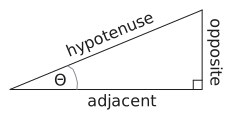
Worked example — finding a side
A ramp makes a \(25^\circ\) angle with the ground and has a horizontal base of \(4\ \text{m}\). Find the ramp's length (the hypotenuse).
Adjacent and hypotenuse are involved, so use cosine:
Worked example — finding an angle
A right triangle has an opposite side of \(6\ \text{m}\) and an adjacent side of \(8\ \text{m}\). Find \(\theta\).
Calculator mode — degrees, not radians
The single most common trig error isn't a maths mistake at all — it's a calculator left in radian mode. \(\sin(30)\) gives \(0.5\) in degree mode but a completely different (and wrong, for this course) number in radian mode. Check your calculator's mode before every exam, not just once at the start of the year — see Using a Calculator below.
Try it yourself: A ladder leans against a wall, making a \(70^\circ\) angle with the ground, reaching \(3\ \text{m}\) up the wall. Find the length of the ladder.
Answer
Opposite (3 m) and hypotenuse involved: \(\sin70^\circ = \dfrac{3}{\text{hyp}} \implies \text{hyp} = \dfrac{3}{\sin70^\circ} \approx 3.19\ \text{m}\)
Algebra
Needed everywhere a formula has to be rearranged before numbers go in — which is most of this course.
The rule: whatever you do to one side of an equation, do to the other — and undo operations in the reverse order to how they were applied to build the expression.
Worked example — simple rearrangement
Rearrange \(v = u + at\) to make \(a\) the subject.
Worked example — rearranging with a square
Rearrange \(v^2 = u^2 + 2as\) to make \(s\) the subject.
Worked example — undoing a square root
Rearrange \(T = 2\pi\sqrt{\dfrac{L}{g}}\) to make \(g\) the subject (the pendulum formula, needed in Motion Relationships).
Isolate the square root first, then square both sides to remove it:
Try it yourself: Rearrange \(F=\dfrac{1}{4\pi\varepsilon_0}\dfrac{q_1q_2}{r^2}\) (Coulomb's Law) to make \(r\) the subject.
Answer
Graphs
Needed for motion graphs (Year 11) and energy/graph-based questions all the way through to Year 12.
Gradient is the rate of change — how steeply a line rises or falls:
Worked example — gradient
A line passes through \((2, 4)\) and \((6, 16)\). Find its gradient.
Area under a graph represents whatever quantity accumulates as the x-axis quantity increases — what it means depends on the graph (covered properly, physics-specific, in Motion Relationships); the mathematical skill itself is just breaking the shape under the line into simple pieces (rectangles, triangles) and adding their areas.
Worked example — area under a graph
A graph rises in a straight line from \((0,0)\) to \((4,8)\), then stays flat at \(y=8\) from \(x=4\) to \(x=10\). Find the total area under the graph.
Triangle (0 to 4): \(\tfrac{1}{2} \times 4 \times 8 = 16\)
Rectangle (4 to 10): \(6 \times 8 = 48\)
Total: \(16 + 48 = 64\)
Try it yourself: A line passes through \((0, 10)\) and \((5, 0)\). Find its gradient, and explain what a negative gradient means in general.
Answer
Gradient \(= \dfrac{0-10}{5-0} = -2\). A negative gradient means \(y\) decreases as \(x\) increases — the line slopes downward left to right.
Scientific notation and significant figures
Needed throughout — see Precision and Uncertainty for how this applies to real experimental measurements specifically; this section is just the raw mechanical skill.
Scientific notation writes a number as \(a \times 10^n\), where \(1 \le a < 10\).
Worked example — converting to and from scientific notation
\(45\,300 = 4.53\times10^4\) (decimal point moves 4 places left, so the power is \(+4\))
\(0.00072 = 7.2\times10^{-4}\) (decimal point moves 4 places right, so the power is \(-4\))
Significant figures — the rules:
- All non-zero digits count.
- Zeros between non-zero digits count (\(505\) has 3 sig figs).
- Leading zeros never count (\(0.0032\) has 2 sig figs).
- Trailing zeros count only if there's a decimal point (\(3.20\) has 3 sig figs; \(320\) is ambiguous — write it as \(3.2\times10^2\) if you specifically mean 2 sig figs).
Worked example — rounding to sig figs
Round \(0.048763\) to 3 significant figures.
The first three significant digits are 4, 8, 7 — look at the next digit (6) to decide whether to round up: \(0.0488\).
Try it yourself: Write \(6\,720\,000\) in scientific notation, and round \(3.14159\) to 3 significant figures.
Answer
\(6.72\times10^6\) (assuming 3 sig figs intended); \(3.14\)
Unit conversion and SI prefixes
Needed constantly — the syllabus explicitly lists the full femto→peta range, and Year 11 measurements routinely land anywhere in it.
| Prefix | Symbol | Factor |
|---|---|---|
| Peta | P | \(10^{15}\) |
| Tera | T | \(10^{12}\) |
| Giga | G | \(10^{9}\) |
| Mega | M | \(10^{6}\) |
| Kilo | k | \(10^{3}\) |
| — (base unit) | — | \(10^{0}\) |
| Centi | c | \(10^{-2}\) |
| Milli | m | \(10^{-3}\) |
| Micro | μ | \(10^{-6}\) |
| Nano | n | \(10^{-9}\) |
| Pico | p | \(10^{-12}\) |
| Femto | f | \(10^{-15}\) |
Strategy: convert to the base unit first (multiply by the prefix's factor), then to the target prefix (divide by its factor) — doing it in two steps avoids sign errors from trying to combine the conversion in your head.
Worked example
Convert \(250\ \text{mA}\) to amps, then to microamps.
To base unit: \(250\ \text{mA} = 250\times10^{-3}\ \text{A} = 0.25\ \text{A}\)
To microamps: \(0.25\ \text{A} = 0.25 \div 10^{-6} = 250\,000\ \mu\text{A}\)
Try it yourself: Convert \(3.2\ \text{nC}\) (nanocoulombs) to coulombs.
Answer
\(3.2\ \text{nC} = 3.2\times10^{-9}\ \text{C}\)
Circuit diagram symbols
Needed for Electric Circuits and every circuit diagram after it.
| Symbol | Represents | |
|---|---|---|
| Two parallel lines, one long one short | Cell (battery, single) | 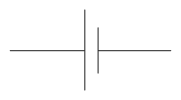 |
| Several cells in a row | Battery (multiple cells) | 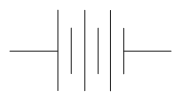 |
| Zigzag or rectangle | Resistor | 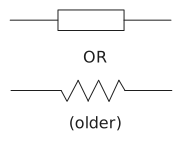 |
| Circle with an A | Ammeter | 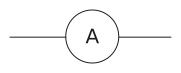 |
| Circle with a V | Voltmeter | 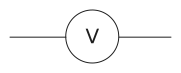 |
| Straight line with a gap and a diagonal switch arm | Switch (open) | 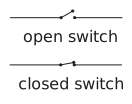 |
| Circle with an X or a coil symbol | Lamp/globe | 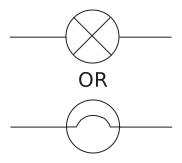 |
| Zigzag with a diagonal arrow through it | Variable resistor (rheostat) | 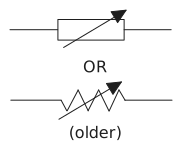 |
| Triangle pointing at a line | Diode | 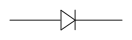 |
| Triangle pointing at a line, with a small arrow | LED | 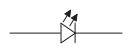 |
| Two parallel lines, no gap | Wire junction/connection | 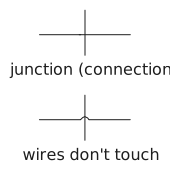 |
Using a calculator
A scientific/graphics calculator efficiently used is a genuine, underrated exam skill — see Resources for the NESA-approved calculator list.
- Degrees vs radians — check the mode before every exam (see the warning under Trigonometry above). This single setting silently breaks every trig calculation if it's wrong.
- Use brackets generously — especially around a numerator or denominator with more than one term (e.g. typing \(\frac{a+b}{c}\) as
(a+b)/c, nota+b/c, which your calculator will read as \(a + \frac{b}{c}\)). - Enter scientific notation with the calculator's own exponent button (often labelled
EE,×10ˣ, or similar) rather than typing^,×,10,^manually — it's faster and avoids order-of-operations mistakes. - Use the ANS button to carry a calculated value into the next line of a multi-step calculation, rather than re-typing a rounded intermediate value — this avoids compounding rounding error across steps (see Precision and Uncertainty).